
It was while living and serving a church in Texas in the early 2000s that I first became fascinated by religious imagination. Driving through the East Texas Piney Woods, somewhere between Austin and Houston, I saw my first Cowboy Church. Today that’s not so unusual—they’ve become a thing—but back then I had never heard of a Cowboy Church. Then a second one, and a third. I saw a trend. I stopped to check one out. It was a humble place: just an empty barn with a “come as you are” sign outside. Another had a sign reading “All Welcome.” I did a quick internet search and found pictures of worship in rodeo arenas and barns, preachers riding Palominos and wearing Stetsons. Imaginative, yes. Inclusive? Not so much.
I filed that away as one of those “that’s interesting” moments. But later that same week, while waiting in line at a San Antonio art-house theater to see Mickey Rourke in The Wrestler, I noticed a rack of pamphlets inviting me to a “Wrestling for Jesus” event. With some research I found an article by blogger Mark Driscoll, complete with pictures of men in tights and masks. Now this was creative. Said Driscoll: maybe God’s call to ministry “leads you to go to seminary, wear a nice suit, and preach to a church congregation each week. And if you feel called to don a skintight wrestling outfit and deliver piledrivers to illustrate the Gospel?”—well, maybe God’s there too. Wrestler Curtis Stone recalled years of traveling between the Deep South and Chicago, making $20 a night and collecting money for drug dealers on the side. One night he broke down in front of his wife. “For the first time in my life,” he said, “I started weeping, and I didn’t understand why.” From that day on he changed his life and wrestled only for Jesus.
Our own tradition has its own expressions of religious imagination. There’s Cabaret Church, created by Rev. Sean Dennison when he served the Tree of Life UU church in McHenry. He called one day to hire me for a Sunday service. “Let’s just do a pulpit exchange,” I replied.
“Oh no—not as a preacher,” he said. “How much would it cost to hire your second-line marching band for my upcoming Cabaret Church?”
Yes, Caberet Church. Dennison writes you may think that “Cabaret” and “Church” have nothing in common.” (Like wrestling or horses.) “And that is the problem in a nutshell,” he says. “We’ve divided our society and ourselves into opposing sides, the spiritual and the carnal, the sacred and the mundane, the serious and the fun. So Why Cabaret? Why not? Why not connect the dots of art, music, creativity, spirit, and community?”
Painter Jennifer Yane puts it this way, Art is spirituality in drag.
Over the years I have photographed, with a completely amateur talent, dozens—perhaps more than a hundred—examples of imaginative religious expression. I’m especially drawn to stained glass and religious architecture, and of course music, which is hard to photograph. I’ve pulled together a few examples to share.
SLIDESHOW including:
“Cosmic Jesus” at the Mormon Visitor Center in Utah
Temple in Bali
Tiffany windows at Arlington Street Church
Taiko drums on Okinawa
Buddhist temple in Kyoto
Unity Temple in Oak Park
Shino cave in Japan
UU church in Rockford
These are just a few examples of religious imagination that have caught my eye. But there is more at work in these eclectic convergences of art, life, and religion. These expressions of the holy aren’t just about having fun; they are about reconnecting people with declining religious traditions. With that decline we are also losing many of the religious references embedded in art, music, literature, film, and our broader culture.
I have long been concerned about the loss of religious literacy—the stories, images, practices, and rituals that humans have shared since we first gathered around fires to wonder at the stars. We are losing a whole set of common metaphors. I was walking one day with a lifelong Unitarian Universalist, and we passed a basement coffee shop called Lazarus Coffee. “That’s awesome,” I said, peering into the cave-like shop. “What’s Lazarus?” my friend replied. “The Bible story?” Nothing. I was a little sad.
Religion gives us something to talk about, to struggle with, to push against—and imaginative names for coffee shops. This matters especially for artists. Go to a museum and look at how much art is religiously inspired, whether in devotion or resistance—often, if you look closely, it is both at once. Art can hold oppositions in tension in ways that prose cannot. Visit a museum with a basic grounding in religion—or better, comparative religion—and you will find sources of endless curiosity and possibility. Go without those cultural references and you’ll find paintings you’ll either like or not, for purely subjective reasons. Listen to Mahler’s “Resurrection” Symphony with a basic understanding of religious tropes and you’ll grasp his themes of death, judgment, and spiritual rebirth. Listen to Bernstein’s “Jeremiah” Symphony and you will catch his musical translation of biblical prophecy, of destruction and outcry of Hebrew people, his plea for humanity’s salvation during World War II.
Artistic expression has long been bound up with religious expression. From the time of Constantine through the Renaissance, religious art was the dominant living art form in the Western world. It may be said that until the late twentieth century, the history of Western art was inseparable from the history of religious imagination. Religious imagination is one attempt to capture something felt but not seen—a force in our lives we know is there, but that we know will never be fully known.
Paul Tillich writes in Theology of Culture that religious symbols “open up a level of reality which otherwise is not opened at all, which is hidden…. Religious symbols open up the experience of the dimensions of this depth in the human soul…. And if new symbols are born, they are born out of the changed relationship to the ultimate ground of being, i.e., to the Holy” (59). These expressions of religious imagination allow us to participate more fully in the world, engaging both the seen and the felt dimensions of creation. James Luther Adams, in On Being Human Religiously, writes that artists are capable of grasping and depicting in imaginative fashion the various dimensions of the human condition. In doing so, they point us toward something universal, or articulate some peculiar perspective or vision of life, form, or color (139).
Cabaret Church and Cosmic Jesus certainly fall into Adams’s category of “peculiar” vision—and the theologian uses that word in its true sense: as something beyond or deviating from the usual or expected. They are curiosity hooks. Variations from the norm to catch our attention—if we’re paying attention.
Then there’s the power of religious imagination, and art, to heal. I bring this as a kind of Mother’s Day offering, for as Kathleen Rolenz in our meditation notes, for some of us Mother’s Day is filled with fond memories–or at least a healthy balance of weighing the good times and bad. For others, the best that might be said about Mother’s Day is it’s just plain complicated.
Which is why I usually assign Mother’s Day to an intern. Hey, they’ve got to learn how to juggle all the feels within a congregation. It’s fair, and exactly what my internship supervisor did for me. But as I was writing this sermon—about art and religious imagination, not at all about motherhood—I looked up a painting that has been on my wall for about 25 years. It was given to my father in the 1980s by a client who owed him a lot of money.
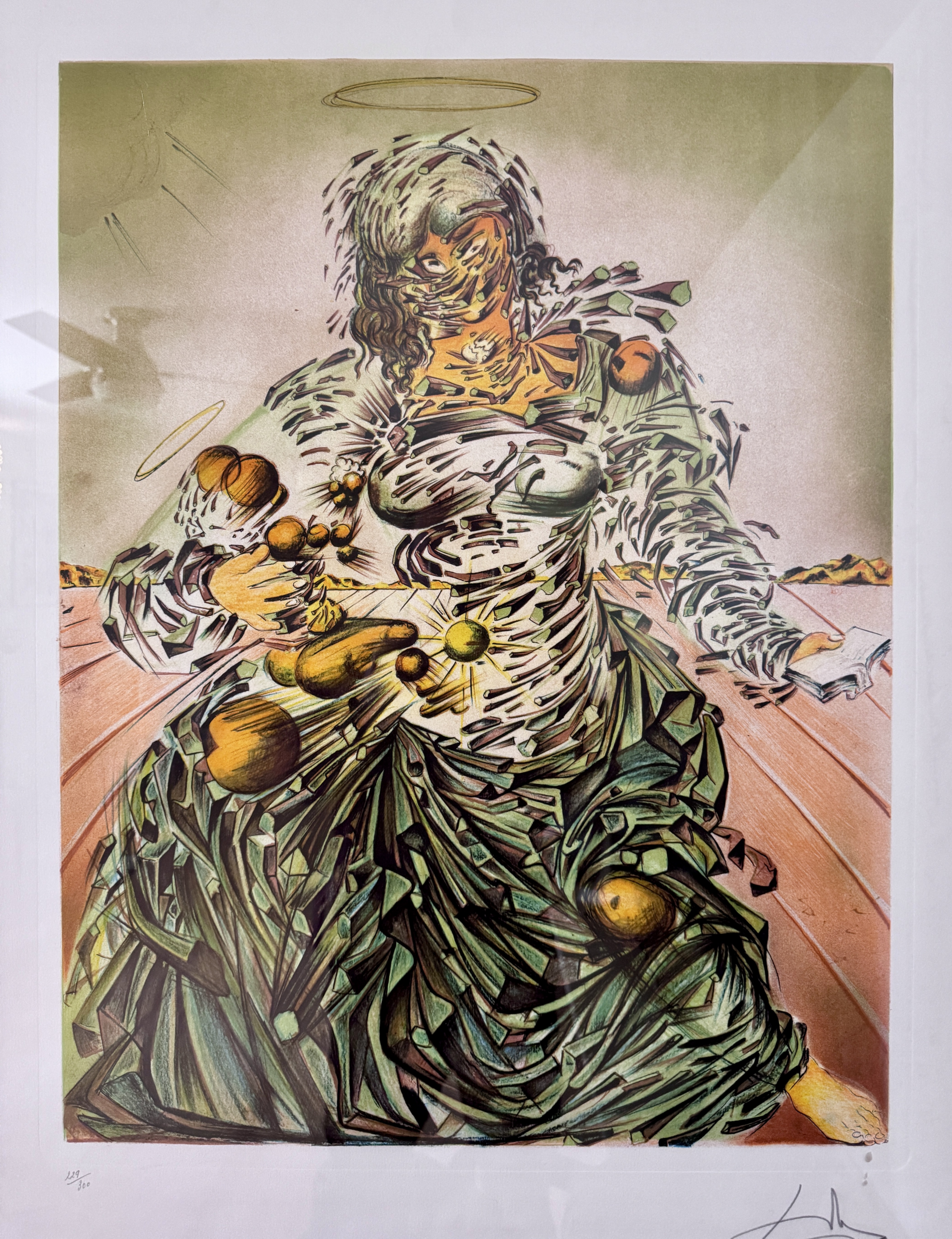
Dad owned a direct mail marketing firm and received a lot of unusual things for payment when clients’ ideas failed: stereo equipment, a motorcycle, once a garage full of Igloo coolers. This particular payment is a numbered lithograph signed by the artist, Salvador Dalí, called Corpuscular Mary—often listed at auctions as “Exploding Mary” or “Exploding Cosmic Mary.” When my father died, my mother—a conservative religious professional—gave it to me because she found it sacrilegious and disturbing. So did I, but I like sacrilegious and disturbing. It’s hung in my living room ever since.
It’s a Madonna and Child—and it occurred to me, as I contemplated this sermon with Mother’s Day somehow in the background, the way this painting has communicated healing to me. There is fragmentation and inner struggle in the painting, represented by oranges and lemons within and emerging from the Madonna’s body. The surrealists used fruit imagery to represent hidden desire, forbidden knowledge, mortality, and the disruption of reality. Notice the egg in Mary’s throat. For Dalí, eggs represented hope, love, and purity—but this egg is fragmented, perhaps taking away her voice and agency. Divine energy seems to vibrate through her as she attempts to cradle the Christ child in one hand and the Word of God in the other. Motherhood in one arm. The Word of God in the other. Which do you think is going to win? For men this may be a rhetorical question. For mothers, I suspect it’s something different.
Whatever pop-psychology we bring, what matters is the painting’s impact. For one viewer, it may be disgust; for another, healing and understanding.
Here again is my concern for religious literacy: religious imagination only works if we have the vocabulary to understand what is happening. Take the Dalí painting. Dalí was intensely religious—so why this depiction of his beloved Virgin Mary, one that other Christians find so troubling? The connection between the Word represented by the book and its utterance represented by the fragmented egg only catches our imagination if we understand something about the Gospel of John—for Dalí, the eternal Word shatters as it is born into human form. Something was happening within the artist. Something happens within us when we encounter it.
And I am not speaking only of Christian literacy. As Unitarian Universalists, we know the deep impact of many sacred stories: the Buddha’s enlightenment beneath the Bodhi tree, the revelation of the Quran to the prophet Muhammad, the Golden Plates of Joseph Smith, the epiphany of Ralph Waldo Emerson—which we discussed a few weeks ago. These are not newspaper accounts of fact, but stories steeped in mythology and the imagining of possibility. For the Buddha, imagining enlightenment. For Muhammad, imagining the purification of soul. For Joseph Smith, imagining a universe filled with attentive aliens and a cosmic Jesus. I’m not making fun, it works for a lot of people. For Emerson, imagining a free faith where Nature and God become one. But without some level of religious literacy, we lose something profound. We don’t know the language. We can’t recognize the connections between art and religion, each forever questioning the other. Did anyone catch the profound—and perhaps ironic—connection between the “Wrestlers for Jesus” and the story of Jacob, wrestling with his angel?
In our reading today, Rev. Christine Robinson articulated the heart of this quest for religious literacy and creative expression: it is to help us imagine possibilities. People come to church to quench a thirst for meaning, to have an authentic experience, to connect with mystery, to imagine possibility—to see ourselves, as it is said, “under the aspect of eternity.” Robinson laments that theme park designers seem to understand what people yearn for better than many worship leaders. Perhaps, she suggests, we could take a cue from Disney’s Imagineers and look carefully at how we cultivate imaginative experience. We need to inspire curiosity and creativity.
The challenge remains. Where will religious imagination take us? As churches wither and close their doors because the stories within have failed to capture our imaginations, how will we respond? Can we imagine new expressions of faith and creativity that reflect who we are today, our desires for creative engagement with a creative universe–and the stories, symbols, images, and themes of traditional religion. That is, the fundamental religious impulse to communicate with a universe trying to communicate with us. As our story earlier suggested, possibility emergerges not from the canvas itself but from the attentiveness and practice of the painter. Practicing with the brush, the senses, the stories and memory.
I doubt we’ll be wrestling for Emerson, or donning cowboy hats for Servetus, or building a Hall of the Cosmic Chalice. But where might we awaken to a creative expression authentic to who we are?
Cultural Creatives have discovered a truth: the true intersection of imagination, art, religion, and possibility lies in attentiveness to the world.
Poet Mary Oliver writes, “This is the first, wildest, and wisest thing I know, that the soul exists and that it is built entirely out of attentiveness.